
Cost estimating is one of those things we assume every project does well. In reality, it’s rarely talked about and surprisingly hard to embed. As I said when I opened our October community webinar, “it’s something that we kind of assume is happening, but very few of us really get into how we make it happen well.”
So we asked someone who has. August Baldassari has around 20 years’ experience in project controls in the energy industry. He works in the PMO of OMV’s Fuels & Chemicals business, where an independent team of estimators supports capital projects from the first idea through to execution.
Key takeaways
- Estimating runs across the whole project lifecycle, not just to get a business case approved.
- Estimate accuracy should be driven by input maturity, not schedule pressure.
- OMV judges estimate quality against six pillars.
- Contingency should reflect each project’s risk profile and contracting strategy.
- August’s top tip: bring your estimators together as a formal team.
Is cost estimating really a PMO “dark art”?
If you’re performing the activities, it’s not really a dark art. It’s quite a structured approach to translating the project scope and strategies into a meaningful cost number.
August Baldassari, OMV
It only looks like a dark art from the outside, because the logic behind the number is usually invisible. A good estimate depends on:
- How mature the project information is
- The assumptions being made
- The market and expected escalation
- The schedule
- The commercial and contracting strategy
When none of that is visible, the number is all anyone sees, and it’s easy to argue with.
Does cost estimating stop once the business case is approved?
No. At OMV, estimating accompanies the project “from cradle to grave”. It moves from order-of-magnitude estimates in the earliest phase to investment-grade estimates before the final investment decision.
That’s where many of us get stuck. We estimate at the start to get the business case approved, then rarely go back to check the quality of the estimate or what has changed.
OMV records its main assumptions at each phase, so when the number moves, the team can explain why. And a different number doesn’t automatically mean a wrong estimate:
It’s always easy to compare cost figures and say the estimate is wrong. It’s not always estimating errors that lead to cost changes. It’s other drivers: the scope, or risks which materialise that have not been properly identified and mitigated.
August Baldassari, OMV
What makes a good cost estimate? OMV’s six-pillar quality framework
OMV’s Cost Estimate Quality Framework gives everyone a shared definition of quality. Its aim is to remove subjectivity and improve consistency across projects.
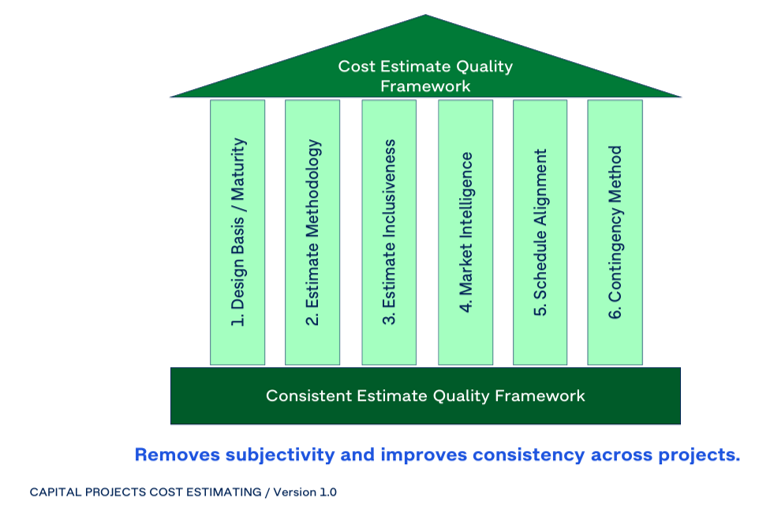
OMV’s Cost Estimate Quality Framework. Source: OMV.
| Pillar | The question it answers | What OMV does |
|---|---|---|
| 1. Design basis and maturity | Is the information good enough for the accuracy expected? | Lets the maturity of the inputs, not the stage gate, set the estimate class |
| 2. Estimate methodology | Does the method match what we know? | Uses factored estimates early, then detailed material take-off estimates once the design is defined |
| 3. Estimate inclusiveness | Have we left anything out? | Sets assumptions for elements that aren’t yet defined, so they’re captured from the start |
| 4. Market intelligence | What is driving cost right now? | Tracks cost drivers, market competitiveness and expected escalation |
| 5. Schedule alignment | When will the money be spent? | Links time-dependent costs, such as escalation, to the project schedule |
| 6. Contingency method | Does the contingency reflect this project’s risk? | Replaces a standard percentage with a project-specific assessment |
Why should input maturity, not the schedule, drive estimate accuracy?
The calendar doesn’t make an estimate more accurate; the information does. In the past, OMV expected a certain accuracy once a project reached a certain gate, even when the inputs couldn’t support it. Now it’s input-driven:
If we have only Class 3 grade inputs, we are not going to classify the estimate as a Class 2.
August Baldassari, OMV
For a PMO, that’s a useful change of question:
| Schedule-driven approach | Input-driven approach |
|---|---|
| “We’ve reached this gate, so we need this estimate.” | “Do we have enough evidence to support this estimate?” |
| Accuracy is assumed from the project phase | Accuracy reflects the quality of the inputs |
| Gaps in information are hidden | Gaps are made visible and escalated |
| The same contingency percentage for every project | Contingency matched to each project’s risk |
Why shouldn’t contingency be a standard percentage?
Because the contracting strategy changes where the risk sits. OMV’s standard cost structure keeps two layers apart:
- The base estimate, which is “model-agnostic”: facilities, owner’s costs and special costs.
- The layers that depend on timing, location and contracting: escalation and inflation, contingency, and the contract risk premium and incentives.
Keeping them apart makes different execution strategies directly comparable.

Capex Cost Estimate Structure – OMV
August described the relationship as “communicating vessels”:
“On the bottom line you may see similar numbers, but the associated risk profiles may be completely different.”
August Baldassari, OMV
| Owner-managed project | Lump-sum turnkey (LSTK) | |
|---|---|---|
| Owner’s costs | Relatively higher | Lower |
| Contract risk premium | Lower | Higher, because the contractor prices in more risk |
| Total cost | May look similar | May look similar |
| What this means for contingency | Reflect the risk the owner keeps | Reflect the risk passed to, and priced by, the contractor |
Are low-carbon projects harder to estimate?
They’re different, and that’s the challenge. They’re one of several changes in OMV’s portfolio that make estimating harder:
- More and bigger projects, which mean bigger teams, a learning curve and a wider spread of project performance
- Greenfield sites, which bring new risks around land, permitting and logistics
- Low-carbon technologies, with many “firsts” and different cost drivers
- New partners, whose input data quality varies
- New contracting models, including more EPC lump-sum turnkey offers
Through all of it, the challenge every estimator recognises still applies: “The estimate should not kill the project.”
We cannot just take our experience from the past and extrapolate it into the future. It’s a different cost structure, it’s different risks, and many of our contractors are pricing in these risks more.
August Baldassari, OMV
Low-carbon projects rely heavily on electrical equipment, which is in high demand, and downstream escalation has now caught up with upstream.
Whenever an organisation makes a less familiar choice, the estimate should be honest about the extra uncertainty that comes with it.
Should cost estimators sit in the PMO?
For OMV, it was a deliberate decision. Other departments only cover part of the lifecycle, while the PMO follows projects from start to finish, alongside assurance, training and portfolio management.
It’s part of a wider trend we’re seeing of specialisms moving into the PMO, such as change managers and benefits teams.
The results are encouraging. Current estimates at completion show better accuracy than in the past. Before, the estimators were individuals spread across the organisation, connecting informally. Working together formally has, in August’s words, reached “a new level of quality”.
How can a PMO embed better cost estimating?
- Bring your estimators together. This was August’s top tip: “They seek informal exchange, but it’s not the same as having established it on a formal basis, which makes faster decisions and faster improvements.” OMV uses regular team meetings and community-of-practice sessions.
- Standardise the process and toolkit. That means a basis of estimate, a scalable estimating template, a cost risk assessment and benchmarking norms. All three OMV refinery sites use the same approach, so “our customers know what they are going to get”.
- Link accuracy to information maturity. When the inputs aren’t good enough, make that visible and escalate it. Don’t let a deadline create false confidence.
- Get “cold eyes” on the estimate. OMV validates and benchmarks estimates using people who haven’t worked on the project before they go through assurance.
- Close the loop. Compare estimates between phases, then feed what you learn from completed projects back into future estimates.
What are the business benefits of better cost estimating?
OMV highlights four:
- Better decision-making, through more reliable and transparent estimates
- Lower cost risk, with fewer omissions, less underestimation and fewer late-stage increases
- More consistency across projects, sites and reviews
- Stronger governance, with clearer accountability between engineering, estimating and commercial teams

Business impact for OMV. Source: OMV.
Getting better at estimating isn’t about more sophisticated spreadsheets. It’s about more confidence in the decisions the numbers support.
Final thought: was your estimate honest about what you knew?
We often judge an estimate by whether it turned out to be right. A better question is whether it was honest about what was known at the time.
You probably don’t need a new tool to get there. Start with consistency, evidence and people.
Thank you to August for sharing OMV’s story.