What Is Risk Management and Why Does It Matter?
According to the APM Body of Knowledge (7th edition), risk management is:
“a process that allows individual risk events and overall risk to be understood and managed proactively, optimising success by minimising threats and maximising opportunities”.
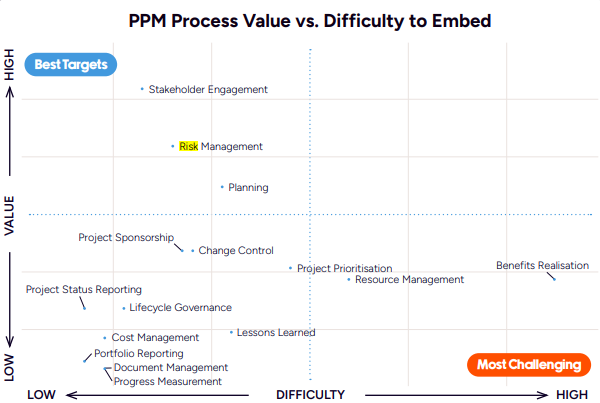
In today’s increasingly uncertain business landscape, the importance of structured, effective risk management has never been greater. Our latest State of Project Management 2025 Report reveals 65% of project managers mostly or always engage in some form of project risk management. It also states that risk management is one of the processes that provides the most value when implemented well.
 Effective risk management enhances resilience, enables innovation, improves forecasting, and builds stakeholder confidence. When implemented consistently across a project, programme, or portfolio, it provides a unified way of understanding risk and using it to inform smarter decisions.
How Do You Modernise Risk Management?
The Axelos Management of Risk (MoR) framework offers seven core principles that are essential for building a modern, scalable, and responsive risk management system. Let’s explore each one with practical guidance and examples to help you apply them.
How Can Risk Management Align With Organisational Objectives?
In the post-2020 era, many organisations have redefined their goals, operating models, and tolerance for uncertainty. Your risk management strategy should reflect the organisation’s current context and appetite for risk.
Action Step: Review your organisation’s strategic objectives and assess how risk is currently factored into goal-setting and planning.
Example: A company undergoing digital transformation may be more open to experimentation, increasing its tolerance for technology-related risks while still needing to mitigate data security threats.
Rule: Align risk assessments and responses to organisational goals, values, and strategic plans. This ensures risk isn’t just monitored but managed in service of value creation.
Should Risk Management Be Tailored to Fit Context?
Not all risks are created equal. A uniform process can lead to over-engineering in low-risk projects or under-preparedness in complex initiatives.
Action Step: Categorise projects based on risk complexity, then assign levels of risk management rigour accordingly.
Example: Business-as-usual changes may require only a basic risk checklist, while major transformation initiatives should follow a detailed risk register, reviews, and escalation protocols.
Rule: Design a dynamic framework that adapts to the size, type, and importance of the initiative to avoid process fatigue and improve efficiency.
How Do You Manage Different Perceptions of Risk Among Stakeholders?
Stakeholders often bring conflicting views on what constitutes a serious risk. These differences must be surfaced and addressed early.
Action Step: Use facilitated risk workshops, visual tools (like risk matrices), and real-world examples to bring clarity and build alignment.
Example: While IT may see system downtime as high risk, customer service may be more concerned with reputational fallout. Both need to agree on prioritisation.
Rule: Build a risk management community of practice to foster shared understanding, promote education, and enhance collaboration.
What Makes Risk Communication Clear and Coherent?
The language of risk should be accessible, consistent, and embedded in everyday project vocabulary.
Action Step: Develop intuitive templates, glossaries, and playbooks that reduce ambiguity in identifying, scoring, and responding to risk.
Example: An internal risk handbook that includes step-by-step workflows and examples can empower teams to own risk activities confidently.
Rule: Ensure guidance is clear, standardised, and readily available within your PMO or project management system to promote consistency.
How Can Risk Management Drive Better Decisions?
Risk data should be a critical input into decisions, not an afterthought.
Action Step: Identify decision points where risk intelligence should be injected (e.g., business case approval, milestone reviews).
Example: If a project exceeds a predefined risk threshold, it should automatically trigger an executive-level review and decision on how to proceed.
Rule: Integrate risk thresholds and governance protocols to support proactive, informed decisions across the portfolio.
Why Is Historical Risk Data So Valuable?
Historical data brings objectivity to planning, forecasting, and mitigation strategies. It prevents organisations from repeating the same mistakes.
Action Step: Build a centralised knowledge base to store and analyse risks, their outcomes, and the effectiveness of the responses.
Example: By tracking which mitigation strategies worked across similar past projects, your team can select proven approaches faster.
Rule: Use lessons learned to refine forecasting, estimation, stakeholder management, and overall project performance.
How Do You Create a Culture That Supports Smart Risk-Taking?
Risk management should not be seen as a compliance burden but as a strategic enabler.
Action Step: Encourage open conversations about uncertainty, support experimentation, and reward transparent risk reporting.
Example: Create a monthly “Risk Forum” where teams can raise concerns or lessons learned without fear of blame.
Rule: Promote a culture where risk is part of everyday thinking, empowering teams to balance boldness with caution.
Understanding Risk Probability and Impact: How Do You Measure Risk?
Risk is generally evaluated across two axes: probability (likelihood of occurrence) and impact (potential consequences). A simple matrix helps visualise this:
| Probability | Impact | Example Risk Type | Suggested Response |
|---|---|---|---|
| Low | Low | Minor tech glitch | Accept |
| High | Low | Frequent UI bug | Mitigate probability |
| Low | High | Rare compliance breach | Create contingency |
| High | High | Critical system failure | Avoid, share, or mitigate |
Some risks require hybrid responses. For instance, a high-impact operational risk might be partially mitigated, partially transferred (e.g. via insurance), and partially accepted if unavoidable.
Tip: When proximity (how soon a risk might occur) is relevant, include it in your matrix to prioritise short-term threats.
What Role Does the PMO Play in Risk Management?
The PMO (Project or Portfolio Management Office) plays a central role in embedding risk maturity across the organisation.
- Framework Owner: Develops and maintains the enterprise-wide risk process.
- Cultural Leader: Champions openness, transparency, and learning.
- Knowledge Hub: Gathers and disseminates tools, templates, and data.
- Governance Enabler: Ensures risk is factored into approvals and escalations.
Action Step: Include risk criteria in all project maturity assessments, and use results to evolve the PMO’s services.
Example: A PMO that tracks risk trends across projects can alert leadership to systemic vulnerabilities early.
How Can You Get Started With Improving Risk Management?
If you’re ready to implement or enhance your risk management approach, begin with training and foundational alignment.
Quick Start Steps:
- Assess current maturity.
- Identify gaps in tools, data, and stakeholder knowledge.
- Deliver foundational training (e.g. Wellingtone’s Risk Management course).
- Pilot improvements with a high-impact project.
- Review and scale based on feedback and lessons learned.
The sooner you embed a practical, people-first risk process, the more resilient and agile your organisation becomes.
Key Takeaways
- Risk management is a strategic enabler, not an admin task.
- Align it with goals, scale to fit, and support with real data.
- Focus on stakeholder consensus, communication, and culture.
- Use a simple risk matrix to help prioritise and respond effectively.
- Let your PMO drive best practices and support decision-making.
- Start small, but make risk management a visible part of how you work.