A P3M3 assessment is an evidence-based review of how well an organisation delivers projects, programmes and portfolios, carried out by a licensed assessor through document review, interviews and workshops. It scores capability from Level 1 to Level 5 across seven perspectives, is framework-agnostic (it doesn’t require PRINCE2, APM or any specific methodology), and can be scoped to a single function rather than an entire organisation.
This article draws on a conversation between Wellingtone’s Emma-Ruth Arnaz-Pemberton (Director of Consulting Services and a licensed P3M3 assessor) and Mike Belch (licensed P3M3 assessor and PMO specialist), recorded as part of our Maturity webinar series.
If you’re new to P3M3, start with What is the P3M3 Maturity Model? for the full breakdown of perspectives, threads and levels. This piece goes further: what actually happens on the ground, what assessors consistently see, and what organisations get right and wrong.
Does P3M3 Only Work With PRINCE2?
A common misconception is that because P3M3 is an Axelos/PeopleCert framework, and PeopleCert is also the home of PRINCE2, an assessment somehow marks you against PRINCE2 compliance. It doesn’t. P3M3 is framework-agnostic: it assesses how well you deliver projects, programmes and portfolios, regardless of whether you run PRINCE2, APM’s approach, Praxis, or a fully agile delivery model. The model looks at outcomes and capability, not adherence to a particular methodology.
P3M3 cares how you deliver projects, not the methodology that you use. You can assess project, programme and portfolio management regardless of what methodology you’re doing.
— Mike Belch, Licensed P3M3 Assessor
The Official Scale Runs From 1 to 5
Worth clarifying, since it’s easy to get wrong: the officially documented P3M3 maturity level scale runs from Level 1 (Awareness of process) to Level 5 (Optimised process). There’s no official “Level 0” in the published model. Assessors will sometimes talk informally about a “level 0” organisation, meaning one with no recognisable project management approach at all, effectively chaotic or ad hoc delivery, but that’s shorthand for “below Level 1,” not a documented part of the framework.
Level 5 is a largely theoretical, optimised end-state that very few organisations ever reach, or need to.
What Are Organisations’ Typical P3M3 Strengths and Weaknesses?
There’s no universal outcome from a P3M3 assessment, every organisation is different, but assessors do see consistent patterns:
| Perspective | Typical Result | Why |
|---|---|---|
| Management Control | Usually strong | Day-to-day reporting, scheduling and progress tracking are well embedded, especially where PRINCE2 is in use |
| Organisational Governance | Usually strong, if a PMO exists | A PMO drives consistent project selection, authorisation and stage-gating |
| Finance Management | Usually strong | Funded delivery naturally requires reasonable financial control |
| Benefits & Requirements Management | Usually weakest | Requirements are rarely captured and change-controlled up front, and benefits tracking after delivery is often skipped entirely |
| Risk Management | Often weak | Risk registers are built early with enthusiasm, then rarely revisited |
| Stakeholder Management | Often weak without a PMO | Less consistently owned in organisations without central PMO structure |
| Stakeholder Management | Often weak without a PMO | Same pattern as stakeholder management |
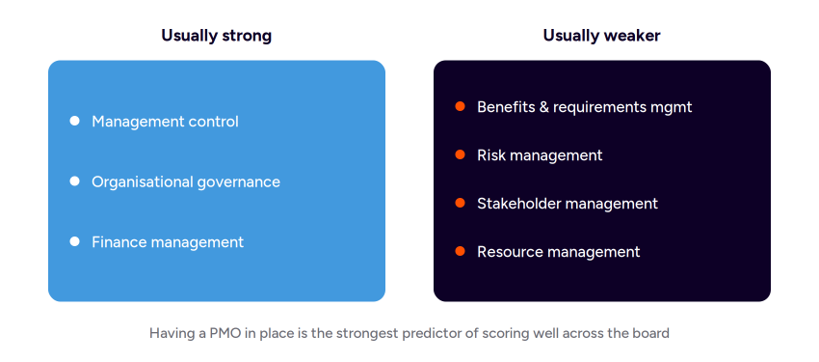
Having a PMO in place is one of the strongest predictors of a higher score. It’s very difficult for an organisation without one to score much above a low level 2, because a PMO is usually what brings the repeatable, consistently applied processes that a level 3 organisation demonstrates.
If risks aren’t revisited, they become a piece of shelfware. Very quickly nobody refers back to it, and then when something bad happens, you get the ‘you should have known this was coming’ conversation.
— Mike Belch, Licensed P3M3 Assessor
Industry also shapes the pattern. Military, defence and nuclear organisations tend to score well on risk and assurance, given the regulatory environment they operate in, while banking or academic institutions often show a different set of strengths and gaps.
Do You Have to Assess Every P3M3 Perspective?
One of the more practical, lesser-known facts about P3M3: not every perspective and thread is mandatory. The model is deliberately tailorable, and part of the planning process is deciding what should actually be in scope.
Understand that the model is flexible, and allows you to take things out and put things in. Some things are definitely mandatory, you’d never want to take out management control and organisational governance.
— Mike Belch, Licensed P3M3 Assessor
For example, if your organisation delivers projects for clients on a fixed time-cost-quality basis and genuinely doesn’t need to track long-term benefits realisation, Benefits Management can reasonably be excluded rather than scored as a weakness you don’t actually care about.
Benefits Management specifically tends to sit more naturally at programme and portfolio level than at project level. If a project-level assessment flags weak benefits management, that’s often a signal that programme or portfolio management isn’t yet established in the organisation, rather than a project-level failing.
Should You Assess the Whole Organisation, or Just One Part?
You don’t need to assess your entire organisation in one go, and often shouldn’t. If you’re a large or multi-division organisation, it can be far more valuable to scope an assessment to a specific function, office or business unit where the need is greatest, rather than spreading a limited number of assessment days thinly across the whole business.
A lot of people use it as a case for change. It’s almost, we’ve got this, and it can help the whole organisation sell that journey.
— Emma-Ruth Arnaz-Pemberton, Director of Consulting Services, Wellingtone
There’s also a natural order to the three models. Most organisations start with a Project Management (PjM3) assessment, then move to Programme (PgM3), then Portfolio (PfM3), since capability tends to build in that direction. Assessing portfolio management before project management is delivering consistently is unlikely to produce a useful result.
What Do Assessors Wish Every Organisation Knew? Lessons Learned
Get the right sponsor, for the right reason.
The single biggest success factor is having a senior sponsor with a genuine reason for commissioning the assessment, whether that’s addressing known poor delivery performance, or building a strategic case for improved maturity. That reason needs to be clearly communicated to everyone being interviewed, so they understand why their honest participation matters.
Be honest about which projects and people you put forward.
Don’t only offer up your best-performing projects, or hand-pick interviewees who’ll give uniformly positive answers, and equally, don’t stack the deck with your harshest critics.
Protect confidentiality properly.
Interview responses need to be genuinely confidential and anonymised, or people won’t speak candidly. Assessors will sometimes hold back specific attributions in their working notes precisely so people can flag real organisational issues without it appearing verbatim in the final report.
Manage group dynamics in workshops.
A senior figure sitting in on a workshop, even with good intentions, can suppress honest input from everyone else in the room. Good assessors watch for this and will step in if one voice is dominating.
What Are the Top Tips for Organisations Being Assessed?
- Plan logistics properly. Before assessors arrive, confirm exactly what’s in scope, get documentation ready, book rooms and calendar slots, and remove friction so assessors can start immediately rather than chasing admin.
- Approach it with an open mind. A P3M3 report is structured around what’s good and what can be improved, not a verdict on what’s bad.
- Know your own ambition. Understand what each level actually represents and be honest about whether your organisation needs, or would benefit from, the investment required to reach the higher levels.
Know thyself as an organisation. Don’t just say we’ve got to get from one to five because five’s the top. Understand that there might not be benefit to your type of organisation to spend the time, effort and money it takes to get to those aspirational levels.
— Emma-Ruth Arnaz-Pemberton, Director of Consulting Services, Wellingtone
What Should You Avoid During a P3M3 Assessment?
- Don’t let interviewees go missing. Assign someone from the PMO to actively chase attendees during the assessment window. A paid assessor sitting idle because an interviewee didn’t show up is wasted time and money.
- Don’t shut down on hearing hard feedback. Disagreeing with a finding is natural, but dismissing it outright means missing the chance to explore why an interviewee felt that way.
- Don’t try to fix everything at once. Prioritise a small number of high-impact, achievable changes first, rather than attempting to action every recommendation simultaneously.
How Long Does It Take to Move Up a Level?
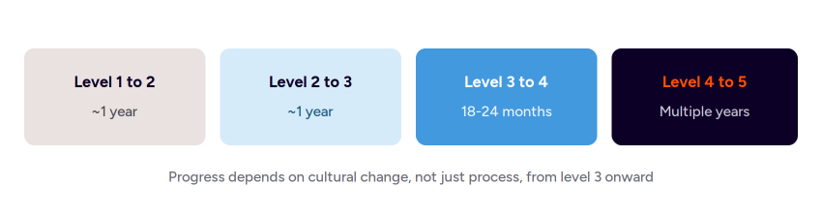
There’s no instant fix, and assessors are consistent on this:
| Transition | Typical Timeframe | Why |
|---|---|---|
| Level 1 to Level 2 | Around 1 year | Achievable through tactical process changes |
| Level 2 to Level 3 | Around 1 year, with a well-planned programme | Still largely process-driven |
| Level 3 to Level 4 | 18 months to 2 years | Requires genuine cultural and behavioural change, not just process |
| Level 4 to Level 5 | Multiple years | Organisation-wide mindset change; very few organisations attempt this |
What Happens After a P3M3 Assessment?
A properly run assessment shouldn’t end with surprises. Assessors typically validate findings with the organisation, sometimes through a closing workshop, before finalising the report, so any factual gaps or disagreements are addressed before publication.
The real value sits in what happens next:

The five steps that typically follow a P3M3 assessment
- Prioritise the recommendations into a roadmap, rather than treating the report as a static document
- Run facilitation workshops, if needed, to help the organisation decide what to act on first
- Deliver the improvement programme, which may be supported internally or with external help
- Check progress after roughly a year with a partial reassessment, to course-correct and re-energise the improvement programme
- Complete a full reassessment at the two-year mark to formally answer “how well did we do,” and set direction for the next phase
This closes the loop between where an organisation started, what it set out to achieve, and what it actually delivered, which is often the most valuable part of the entire exercise for demonstrating return on investment to stakeholders.
Frequently Asked Questions
Listen to the companion podcast
Mike Belch & Emma-Ruth Arnaz-Pemberton give an overview of the Axelos P3M3 maturity model as well some of the typical things that organisations do right and wrong, whilst sharing their experience of completing assessments.