There’s no single “maturity assessment.” There are four common types, and each one tests a different part of the organisation. A PPM assessment looks at your project, programme and portfolio practice. A PMO assessment looks at how well the PMO enables delivery. A Capability and Skills assessment looks at the people actually running your projects. A Benefits Realisation assessment looks at whether the change delivered what it promised. The right one depends on the problem you’re actually trying to fix, not on booking “a maturity assessment” because it sounds like the sensible thing to do.
I get asked some version of this almost every week. Someone tells me “we think we need a maturity assessment,” and my first question back is always the same. Which one?
I’ve written before about PMO Maturity Assessment vs. P3M3, which is about how deep to go once you already know you need a PMO or PPM assessment. This one sits a step earlier. Before you choose how formal or how deep to go, you need to know what you’re actually testing, because a lot of organisations point the assessment at the wrong problem entirely, and then wonder why the recommendations don’t land.
44% of organisations are somewhat or very dissatisfied with their current level of project management maturity.
Wellingtone State of Project Management Report
Our own State of Project Management research puts it plainly: 44% of organisations are somewhat or very dissatisfied with their current level of project management maturity. That figure has barely moved in years, and in my experience it’s not because people aren’t trying. It’s because “maturity” gets treated as one thing to fix, when it’s actually four quite different things.
What Is a Project Management Maturity Assessment, Really?
At its simplest, a maturity assessment is an independent, evidence based look at how well an organisation delivers change. Most models score you against five levels (Initial, Defined, Standardised, Managed, Optimised), and benchmark you against other organisations so you’re not just marking your own homework. If you want the full picture of how that works, our guide to project management maturity covers it in more depth.
Here’s the bit that gets missed, though. Maturity isn’t one dimension. It shows up differently depending on where you look: in delivery practice, in the PMO, in people’s skills, or in whether anyone ever goes back and checks the benefits actually landed. That’s why I don’t believe in a single, generic maturity assessment that answers everything at once.
Why Isn’t There Just One Type of Maturity Assessment?
Because organisations don’t have one type of problem, they have several, and they’re rarely all the same size. I’ve worked with teams who have excellent governance and a genuinely well run PMO, and they still struggle because the people actually delivering projects were never trained to do it. I’ve worked with others who deliver everything on time and on budget and still can’t tell you, honestly, whether any of it was worth doing.
Four different problems, four different focuses in terms of assessments. That’s the key to all of this. Don’t just go out and buy a generic project management review. What you want is something that’s going to work in your reality.
Emma Arnaz-Pemberton, Director of Consulting Services
Every time I run one of our community sessions on this, I put the same four pictures up on screen, because it’s the quickest way I’ve found to get a room full of PMO leads nodding at four completely different pain points:
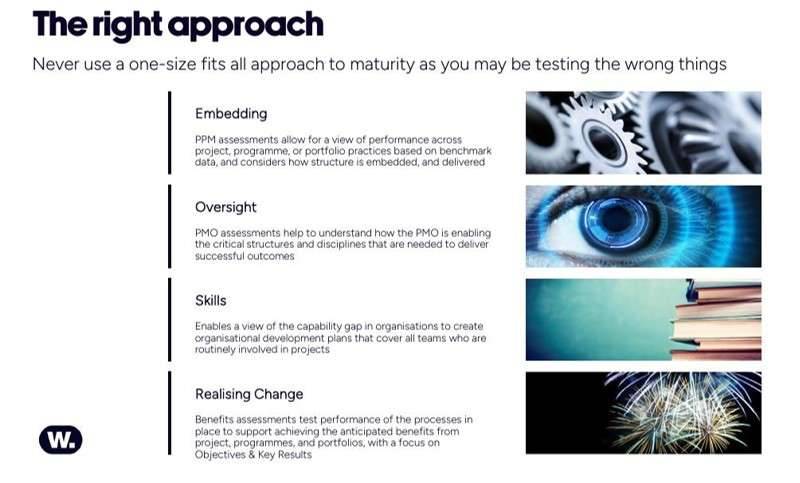
Never use a one-size-fits-all approach to maturity. You may end up testing the wrong things.
Here’s how the four line up side by side:
| Assessment Type | What It Tests | Best Suited When… | Typical Outcome |
|---|---|---|---|
| PPM Maturity Assessment | Project, programme and portfolio practice as a whole | Delivery is inconsistent from team to team or project to project | Benchmarked score plus a practical improvement roadmap |
| PMO Maturity Assessment | How well the PMO enables delivery, not just how projects run | No real oversight; the PMO is seen as admin, not a strategic partner | PMO structure, remit and service catalogue recommendations |
| Capability & Skills Assessment | Knowledge, behaviours and competencies of everyone involved in change | Subject matter experts are running projects untrained; sponsors are inconsistent | Skills gap analysis and development pathways |
| Benefits Realisation Assessment | How benefits are defined, owned, measured and tracked | Delivery is reliable but nobody can evidence the return | Benefits framework, governance and measurement recommendations |
Is Your Problem Really About PPM Delivery?
If projects get delivered differently depending on who’s running them (different templates, different levels of rigour, different governance from team to team) the issue usually sits at the PPM level. That’s shorthand for your combined project, programme and portfolio practice.
A PPM Maturity Assessment gives you a view of performance across all three, benchmarked against other organisations, and looks at how the structure is designed, embedded and actually delivered, not just how it reads on paper.
- Best suited for: organisations with no consistent methodology, or one that exists in a folder somewhere but isn’t actually followed
- Worth knowing: roughly a third of projects still aren’t formally baselined. If you can’t measure where a project started, it’s hard to say honestly whether it delivered
Once you’ve got a result back, our guide on building a maturity roadmap covers what to do with it. And if what you actually need is ongoing, independent checks on live projects rather than a point-in-time score, that’s closer to our Project and Programme Assurance service.
Is the Problem Actually Your PMO?
Sometimes the delivery practice itself is fine, but there’s no central point pulling it together. Nobody’s collating data, chasing dependencies, or acting as a source of truth. This is where a PMO assessment earns its keep, because it doesn’t just re-test project mechanics, it looks specifically at how well the PMO enables them.
This is an easy gap to miss. Plenty of generic assessments will score how well an organisation does resource management, for example, without ever asking how well the PMO enables that resource management to actually happen. Those are two different questions with two different answers.
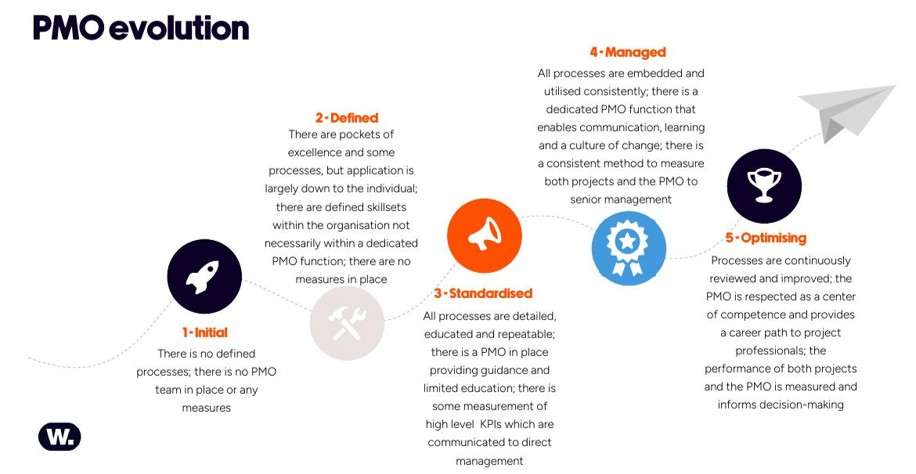
The five stages of PMO evolution. Most organisations start assessing maturity around stage 2 to 2.5.
- Best suited for: organisations without an established PMO, or one that’s seen as an admin function rather than a genuine strategic partner
- Worth knowing: 67% of PMO professionals believe their team’s scope and responsibilities are going to grow, which is worth bearing in mind before you design a PMO that only fits today’s remit
If this sounds like you, our PMO Consultancy and Transformation work is built around exactly this problem.
Could This Be a Skills Gap Instead?
If your frameworks and your PMO are both reasonably solid and delivery still wobbles, look at who’s actually running the projects. A lot of organisations lean on subject matter experts who’ve never had any formal project management training. I call these “accidental project managers,” and they usually don’t get much support once they’ve fallen into the role. Others have sponsors who each take a completely different approach, which means a delivery manager working across two or three of them is having a different experience every single time.
A Capability and Skills Assessment looks at the knowledge, behaviours and experience of everyone routinely involved in change, not just the PMO team, including how well HR and leadership development actually support project skills.
- Best suited for: organisations relying on untrained SMEs to lead delivery, or seeing very different results depending on which sponsor is involved
- Typical outcome: a capability gap analysis, role or competency frameworks, and a development pathway people actually use
This is also usually where training comes in rather than another assessment. Our APM Endorsed courses include a PMO Practitioner course for exactly those accidental project managers, and a Sponsoring Successful Projects course for the sponsors who all seem to be doing it differently.
Can You Prove the Change Was Worth It?
This is the one that’s easiest to miss entirely, because delivery can look perfectly healthy: on time, on budget, signed off, while the organisation still can’t answer a much simpler question. Did we get what we were expecting?
We know that benefits realisation is one of the main dark arts of project management.
Emma Arnaz-Pemberton, Director of Consulting Services, Wellingtone
Benefits realisation consistently comes up as one of the hardest processes for organisations to embed, alongside resource management and prioritisation. In my experience it’s rarely that the process doesn’t exist. It’s that it loses momentum. Organisations write a solid business case at the start because they have to, and then ownership quietly disappears the moment the project closes. Our Benefits Management and OKRs work usually starts exactly here.
- Best suited for: transformation programmes, public sector portfolios, or any organisation that delivers reliably but can’t evidence the outcome
- Typical outcome: a benefits framework review, clearer ownership, and often a recommendation to adopt something lighter, like OKRs
So How Do You Actually Choose?
Start with the symptom, not the assessment. What you’re feeling day to day is a far better guide than picking a model off a shelf because it’s the one you’ve heard of.
If you’re really struggling with a skills gap, doing a standard project management maturity assessment isn’t going to answer all of your questions. It’ll give you an answer, but it won’t be targeted to your reality.
Emma Arnaz-Pemberton, Director of Consulting Services, Wellingtone
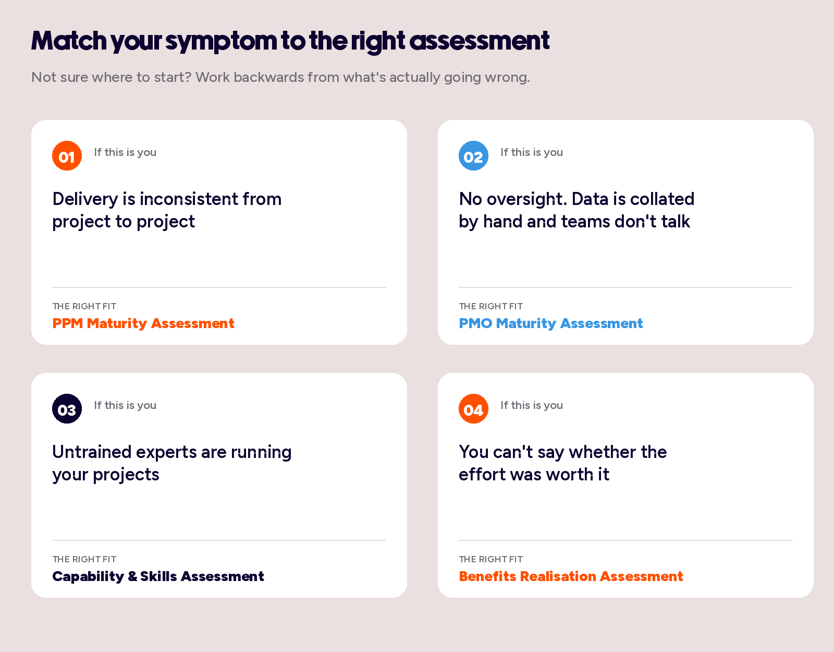
Match your symptom to the right assessment
It’s also worth saying plainly: most organisations don’t need just one of these, and you rarely need all four at once. A common pattern I see is a PPM or PMO assessment first, to build the case for change and establish a baseline, followed by a targeted skills or benefits assessment once the specific weak point becomes obvious.
What Does Getting Started Actually Look Like?
- Take stock of where you actually are. Honestly, not aspirationally
- Define what “better” looks like for your organisation. It’s rarely a straight run to level 5
- Identify the specific gap between the two, and build a plan around it
- Communicate early with anyone you’ll need to involve. Interviews and data requests land a lot better with some warning
- Be honest about your organisation’s own “dark arts,” the things you keep trying and just can’t quite land
None of this needs to happen in isolation, either. Our Wellingtone Community is free to join, and it’s exactly where these four scenarios get talked through openly by people going through the same thing.